
For shipowners and fleet managers evaluating where to source their next crew, the decision is rarely just about cost. It comes down to a harder question: which manning agency can consistently deliver certified, competent, and reliable seafarers across every vessel type in your fleet, without compliance risk or crew-change delays? For a growing number of international shipowners, the answer points to Bangladesh — and specifically, to manning agencies with the scale, certification, and training infrastructure to back it up.
This article looks at the decision from a fleet owner’s seat: what Bangladeshi seafarers bring to each vessel category, how that translates into operational reliability, and what to check before you commit a manning contract.
A Fleet-Ready Talent Pool
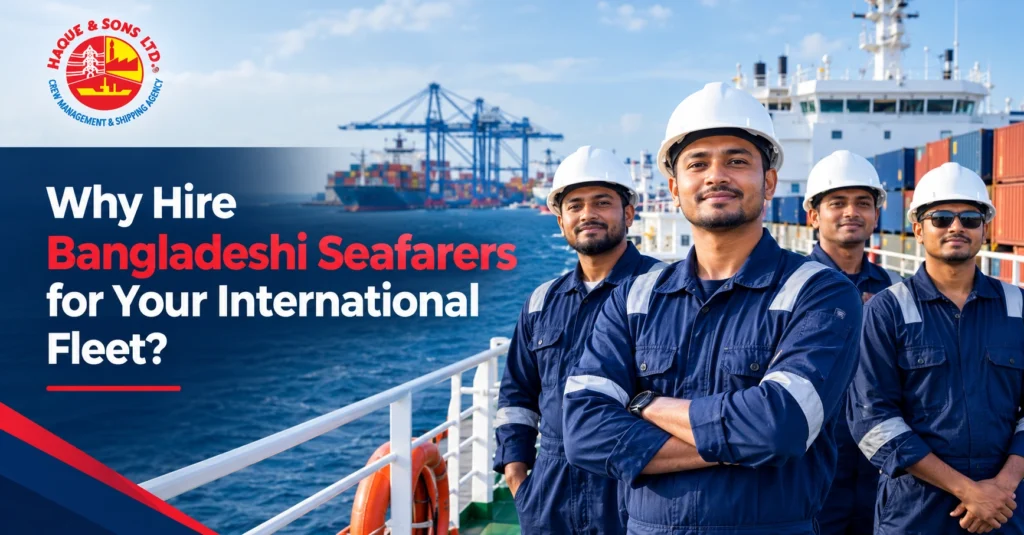
Bangladesh today trains and deploys seafarers across nearly every vessel class in global shipping — container carriers, chemical and crude oil tankers, product tankers (Handymax to VLCC), bulk carriers (Capesize to Handymax), general cargo, LPG and LNG carriers, car carriers, and log carriers. For a fleet manager, that breadth matters: it means a single manning partner can crew a diversified fleet instead of juggling multiple agencies per vessel type.
Haque & Sons Ltd., for instance, maintains a pool of 4,500+ STCW-certified seafarers — 1,900+ ratings and 2,600+ junior and senior officers — supporting 240+ vessels across these categories. That scale is what allows a manning agency to guarantee replacement crew on short notice, rather than scrambling when a seafarer’s contract ends mid-voyage.
If your fleet mixes vessel types, read our complete guide on crew management services to see how a single manning partner can cover recruitment, deployment, wages, and compliance across your entire fleet.
Certification and Screening Standards That Match International Benchmarks
The biggest risk in crew sourcing isn’t finding seafarers — it’s finding seafarers who will pass vetting, perform under PSC inspection, and hold up to flag-state and P&I scrutiny. Bangladeshi seafarers deployed through established manning agencies are STCW 2010-compliant, and reputable agencies screen candidates through interviews conducted directly by Master Mariners and Chief Engineers — not HR generalists.
This is worth asking any manning agent directly: who interviews your candidates, and what is your rejection rate? Agencies that can answer with specifics (rather than general claims) are the ones worth trusting with a long-term manning contract.
For a deeper look at how recruitment and selection actually works end-to-end, see our complete guide to seafarer recruitment and selection.
Compliance Infrastructure Reduces Owner Risk
An international shipowner isn’t just hiring a seafarer — they’re inheriting the compliance posture of the agency that sourced them. MLC 2006 compliance, P&I coordination, wage processing accuracy, and welfare standards all sit with the manning agency, and gaps here create real liability for the vessel owner.
Agencies holding ISO 9001:2015 certification (audited by bodies like DNV) and MLC 2006 certification are operating under an external quality framework, not just internal promises. This matters most during PSC inspections, P&I claims, or a crew welfare dispute — situations where documentation and process discipline directly protect the shipowner.
Our article on how crew management reduces operational risk for shipowners breaks this down in more detail if your fleet has had compliance friction with a previous manning provider.
Built-In Training Pipeline, Not Just a Recruitment Database
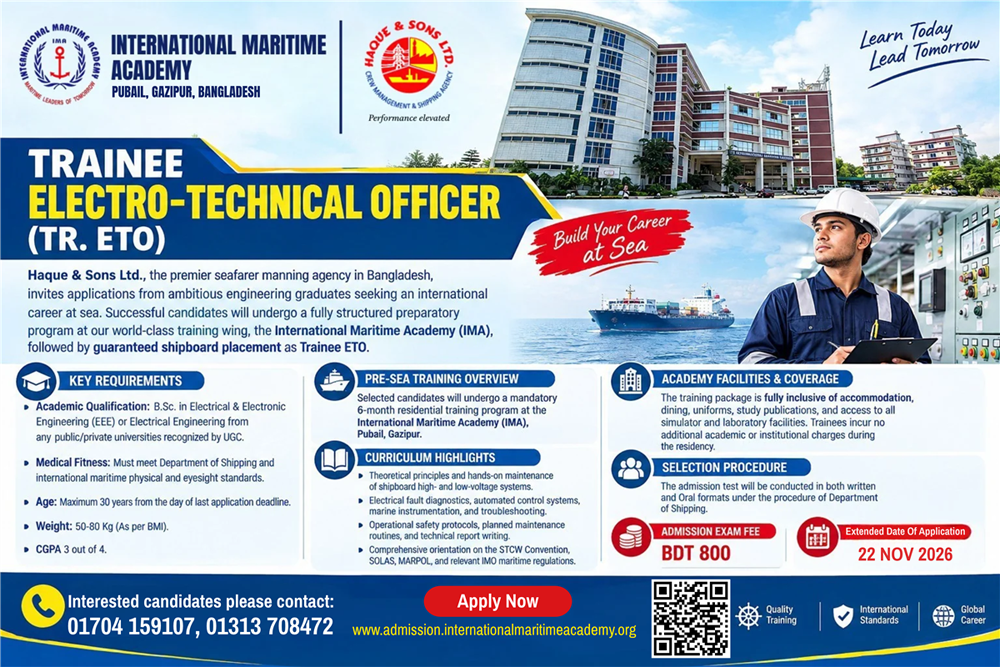
One structural advantage of established Bangladeshi manning agencies is ownership of the training pipeline itself. Rather than outsourcing training and hoping certificates are genuine, agencies like Haque & Sons operate their own institutions — the International Maritime Academy (IMA) for pre-sea training and the Bangladesh Maritime Training Institute (BMTI) for continuous upgrading, including specialized courses like LNG and methanol bunkering protocols.
This closes the loop between training quality and deployment — the agency isn’t just placing seafarers, it is directly accountable for how they were trained. Learn more about this model in our crew training and education services, and in our guide on STCW certification validity and renewal for Bangladeshi seafarers.
Cost Efficiency Without Compromising Competence
Cost is a legitimate factor, but it should never be the only one. What makes Bangladeshi crew cost-competitive isn’t lower screening standards — it’s a large, well-trained labor pool combined with lower regional wage benchmarks relative to crew-exporting competitors. Shipowners who evaluate purely on day-rate without checking certification and compliance infrastructure often pay for it later in PSC detentions, crew turnover, or claims.
The responsible way to evaluate cost is: certified competence per dollar, not lowest day-rate alone.
What to Check Before Signing a Manning Contract
Before engaging any manning agent or agency for your fleet, verify:
- Certification base: ISO 9001:2015 and MLC 2006 status, and who certified them
- Screening process: who conducts interviews, and what disqualifies a candidate
- Fleet coverage: does the agency have a track record across your specific vessel types
- Replacement speed: how fast can they deploy a relief seafarer
- Representative presence: does the agency have contacts in your operating regions for faster communication
Partner With a Manning Agency Built for International Fleets
Haque & Sons Ltd. has been crewing international vessels from Bangladesh since 1972, with over five decades of operational history, ISO 9001:2015 and MLC 2006 certification, and representative offices in Japan, Canada, and the United States for direct principal communication.
If you’re evaluating manning partners for your fleet, contact our crew management team to discuss your vessel types and crewing requirements, or explore our full range of maritime services.
Frequently Asked Questions
Is Bangladesh a reliable source for seafarers across all vessel types?
Yes — Bangladesh trains and deploys officers and ratings across container, tanker, bulk, gas, and general cargo vessel categories, supported by STCW-approved training institutions.
How do I verify a Bangladeshi manning agency’s certification?
Ask for their ISO 9001:2015 certificate (and the certifying body, e.g., DNV) and MLC 2006 certification documentation directly, and confirm membership in bodies like InterManager, IMEC, or ISWAN.
What’s the typical replacement timeline if a seafarer’s contract ends mid-voyage?
This depends on the agency’s talent pool depth and representative network — ask for average relief-crew deployment time before signing.