
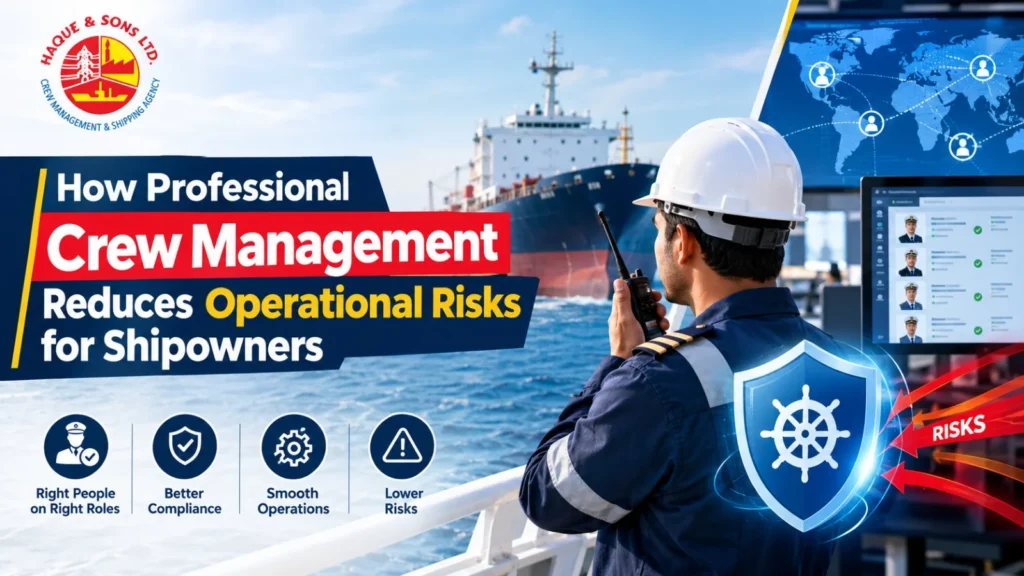
Professional crew management is crucial for shipowners to minimize risks in their operations. Being on deck of a commercial ship is more than just keeping track of the engines, cargo and a voyage plan. Team members who work on the vessel can directly affect aspects of safety, compliance, efficiency, and reaction in the event of an accident. The reason is that professional crew management is a crucial element in risk management for today’s shipowners.
The aim is not just to get people on the ship. It is to ensure that the right people are ready, are prepared, and are supported, to ensure that operational risk can be identified and controlled before it becomes a costly problem.
What is Professional Crew Management?
Professional crew management is the structured approach of planning, attracting, screening, training, deploying, supporting and monitoring seafarers during their working life. Learn more about the full scope of crew management services that a professional provider typically covers.
It can deal with the crew requirement, sourcing of candidates, certificate verification, medical examinations, joining documents preparation, crew change arrangements, monitoring of contract and replacement preparations, etc.
This can be linked to risk management, which in turn is closely related to crew management. The International Maritime Organization’s International Safety Management (ISM) Code sets an international standard for the safe management and operation of ships and pollution prevention, and Risk Assessment, Safeguards, Competent Personnel and Shore-based Support are an important part of an effective Safety Management System.
Why Crew Management Is an Operational Risk Issue
There are many maritime hazards that have a human component.
Operational incidents may be caused by navigation errors, communication issues, unawareness of the problem, poor emergency response, incorrect maintenance procedures, fatigue, lack of familiarization, and non-compliance with safety procedures.
That is not to say that all incidents are a result of crew members. Maritime operations are complex and can be caused by equipment, weather, procedures, management decisions, port conditions and others.
Better Recruitment Reduces the Risk of Poor Crew Matching
Better recruitment and selection is one of the first steps in mitigating operational risk with professional crew management.
Just because one person has the proper rank doesn’t mean they are suitable for all ships. It can be influenced by the type of ship, the machinery, the goods to be carried, the trading area, the complexity of the operation and past experience.
For instance, one ship officer who has plenty of experience on a chemical tanker might not have the same amount of hands-on experience on an LNG carrier. There may be specific training and operational knowledge needed for specialized vessels.
Competency Verification Helps To Avoid Gaps In Qualification
Certificates are crucial, but professional crew management is not just a matter of having a certificate.
It is important for recruitment teams to confirm the authenticity of the appropriate Certificates of Competency, Certificates of Proficiency, endorsements, training records, medical certificates and other necessary documents. Our guide to STCW certification, validity and renewal explains what shipowners and seafarers need to keep track of.
This helps to minimize the chance of finding a documentation or competency issue just before the ship is due to sail.
Vessel Familiarization Helps To Minimize Confusion Onboard
Even a qualified seafarer must be familiar with the particular company’s and ship’s protocols.
There are many variations in ships in terms of equipment, layout, safety management systems, cargo configurations, machinery, emergency systems and practices. It is important to help the joining crew member become familiar with these differences before assuming responsibility.
This change is facilitated by professional crew management, which ensures coordination of the information and training required.
This is especially significant when personnel are transferred from one vessel to another by two entities and/or different types of vessels.
Proper Manning Takes Steps To Eliminate Fatigue
Fatigue is one of the key problems of shipboard work.
Long hours, irregular watches, the rigours of port operations, extreme weather conditions, night-time activity and lack of rest may lower alertness and lead to the risk of errors.
IMO guidance on fatigue also highlights that manning should match the operational workload, and that there are predictable and unpredictable demands — such as training, illness, port operations and other interruptions — that companies must take into consideration.
Efficient Crew Rotation Minimizes Operational Disruption
Professional crew management organizes crew changes in advance, considering the terms of the contract, travel arrangements, the schedule of the ships, visa documents (if any) and the validity of documents, often coordinated through marine travel and logistics support. See our practical crew change guide for Chattogram Port for a look at how this works in Bangladesh.
Shipowners have more time to find suitable replacements, and better planning reduces the chance of last-minute recruitment.
Training Assists Crew Responding To Emergencies
Routine operation is just one aspect of a crew’s duties. Ships have to be ready to deal with emergencies like fire, flooding, machinery failure, collision, grounding, medical incidents, cargo issues and other unforeseen events.
This is especially relevant for specific tasks, such as the possession of vessel-specific or cargo-specific competencies by crew members.
This isn’t about removing all possible emergency situations. It is designed to enhance preparedness to allow the crew to react in an organized way in the event of an unplanned occurrence.
Strong Documentation Reduces Compliance Risk
Documentation issues can turn into operational issues.
Expired certificates, lack of endorsements, missing medical records, incomplete employment documents or incomplete training documents can cause problems when inspections, audits, crew changes or vessel operations are conducted.
A professional crew management system tracks and maintains organized records and monitors key expiry dates.
Digital crew management platforms can help streamline this process with notifications and access to relevant documents.
This does not take the place of human verification but may help minimise important information being missed.
Improved Ship-to-Shore Communication
Crew management also establishes a valuable link between the ship and the company’s port-side staff.
Seamless communication can be used to resolve recruitment and relocation concerns, health and hygiene issues, training needs, employee well-being, and other issues that may arise before they become a problem.
This benefit is particularly useful if a vessel is a long way from the company’s office.
Crew Welfare Can Contribute To Operational Stability
Sometimes crew welfare is not considered a separate issue from operational performance, but the two are closely related.
Seafarers work in harsh conditions and spend months away from their families. If welfare is poor, if issues go unaddressed, or if workload is too high and support too low, dissatisfaction and retention issues can arise.
Professional crew management allows shipowners to maintain a communication system, welfare system, contract system and repatriation system — part of the broader career and welfare support a strong crew manager provides.
Proper support of seafarers can help increase continuity and more stable crew planning.
Performance Monitoring Helps Spot Recurring Problems
Professional crew management shouldn’t stop once a seafarer boards the ship.
Past performance, feedback from masters and managers, training records and prior experience on a specific vessel can all be useful when considering future crew selection.
If a specific seafarer is successful on a particular kind of ship, that knowledge would be beneficial for future assignments. Likewise, recurring training or performance problems may point to a training need that requires further support.
The intent isn’t to draw conclusions from a single incident, but to use patterns over time to keep improving crew planning and development.
Professional Crew Management Helps With Unexpected Events
Seagoing operations seldom run smoothly.
One member of the crew can develop an illness prior to sailing. A ship can get stuck in a situation that causes delay. Emergency repatriation may be necessary for a seafarer. An operational requirement might suddenly shift, or a certificate may need renewal sooner than anticipated.
This does not ensure that any crew-related problem can be resolved instantly, but it may reduce the need for rushed, last-minute decisions.
How Crew Management Contributes To The Shipowner’s Safety Management System
Crew management should be an integral part of the overall Safety Management System, not a separate system from it. This is closely tied to broader quality assurance standards across a shipowner’s operations.
General safety goals can then be supported through crew-related procedures such as recruitment requirements, training and familiarisation, fatigue management, reporting, competency checks and emergency preparation.
Effective dialogue between the crew management function ashore and the function of running the vessel can help identify risks early and address them in a more systematic manner.
The Role of a Professional Crew Management Company
When shipowners have to process a lot of hires and are handling crew administration on their own, a lot of time and resources can be spent on each of these tasks.
A professional crew management company would offer focused and dedicated resources for recruitment and selection, documentation, training coordination, crew scheduling, travel arrangements, welfare and replacement planning.
For instance, Haq Sons can serve as a partner to shipowners for crew management and maritime services, assisting them in finding crew with the requisite skills and managing the administrative workflows involved in crew deployment.
The specific services provided may differ from one crew management company to another, so a shipowner should evaluate a company based on its recruitment process, regulatory compliance, verification standards, experience with relevant vessel types, communication systems and ability to provide support throughout the process.
Frequently Asked Questions About Professional Crew Management
Crew Management in Shipping: What is it?
Crew management is a process that involves the recruitment, selection, training, deployment, support and administration of seafarers as they work on a vessel or with a shipping company.
What are the benefits of crew management in reducing operational risk?
It provides benefits in crew selection, verification of crew qualifications, training, matching of vessels, documentation, rotation of crews, fatigue management, and crew replacement.
What is the significance of having a competent crew on a ship for safety?
There are many safety-critical activities on board a ship. Skills and competence are identified by the IMO as an integral part of safe and effective maritime operations.
Are there ways to minimize fatigue with crew management?
Yes. Good crew planning can help shipowners ensure they have the correct number of crew on board, make efficient crew changes, and account for workload and rest. IMO guidance directly relates manning and workload to fatigue risk.
How are crew management and the ISM Code related?
The ISM Code is an international standard for the safe management of ships and the prevention of sea pollution. It covers crew competence, resources, support ashore, risk assessment, and safety procedures.
Why is experience on a particular vessel type important when choosing crew?
Machinery, cargo systems, equipment, procedures and operational requirements may vary between different ships. Matching seafarers with relevant experience on similar vessels can contribute to safer and more efficient operations.
Does professional crew management remove all risk from the sea?
There are always risks in maritime operations, arising from human, technical, environmental and commercial sources, among others. Professional crew management is part of a wider risk-management and safety-management system.
Final Thoughts
Professional crew management is more than an administrative service to shipowners. It’s a component of the larger operational risk management framework.
The right crew requires more than just the right job title. They must have the right qualifications, proper documentation, relevant work experience, enough training, familiarization, adequate rest and effective support from shore.
Professional crew management will continue to play a crucial role in the safe, compliant, and efficient operation of ships in the future, as maritime regulations, technology, and vessel systems and demands evolve. To discuss how Haq Sons can support your fleet’s crewing and risk management needs, get in touch with our team.