
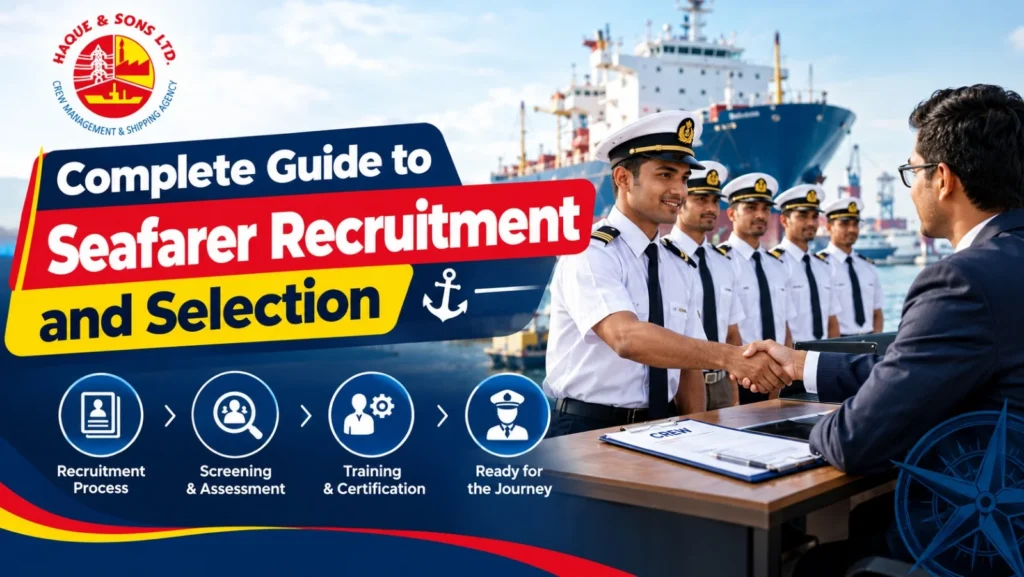
Seafarer recruitment and selection is one of the most important processes in ship management. Whether it is the deck, engine, safety, cargo or support crew, a ship relies on competent individuals to ensure operations, safety and compliance with regulations and industry standards, and crew selection has far-reaching effects on all these aspects.
Seafarer recruitment and selection differ from conventional recruitment in that it includes assessing maritime qualifications, certificates, sea service, medical fitness, training, experience and suitability for a specific ship and job. Holding the required certificate does not necessarily mean the candidate is right for the ship, rank, cargo type and environment.
This isn’t just about filling vacancies for shipowners and managers. It is about creating a qualified, well-documented and trustworthy crew that meets the needs of the ship, flag State, company and international standards.
Seafarer Recruitment and Selection: What is it?
Seafarer recruitment involves the process of identifying and finding skilled seafarers for a ship. The next step is selection, which involves evaluating candidates to see if they possess the necessary attributes for a specific job.
It will likely consist of masters, chief officers, deck officers, ratings, engine mechanics, catering staff, electro-technical officers, engine ratings, and other specialists depending on the ship.
A professional recruitment process needs to ensure that seafarers are not subjected to inappropriate recruitment practices. The Maritime Labour Convention 2006 provides for an efficient and regulated system of seafarer recruitment and placement services, and where such services are provided on a private basis, they are expected to be licensed, certified or regulated as appropriate.
The Importance of Proper Seafarer Recruitment
Ship performance is closely related to the capability of the crew. Poor selection may lead to operational errors, lapses in watchkeeping, safety problems, document issues, crew conflict, and failure to comply with company or flag-State requirements.
The results can be more than just a job loss. For instance, if an inexperienced officer is assigned to a vessel with complex shipping activities, he or she might need extra supervision. Likewise, a crew member with a certificate that is not appropriate for the vessel may present a compliance issue even before the ship leaves the dock.
Professional crew management can include the tasks of identifying crew candidates for companies like Haque & Sons Ltd., assisting with documentation, screening and placement for international maritime applications by connecting shipowners with appropriate candidates.
Step 1: Identify the Crew Requirement
The first step in recruitment is knowing what the vessel needs.
The necessary rank, date of employment, type of vessel, trading area, length of contract, experience, certificates, and specialization training for the position should all be determined by the shipowner or manager.
For instance, a chief engineer on a container ship might have different practical experience compared to a chief engineer who has spent a long time on tankers. Both are likely to have the relevant basic qualifications, but their experience with particular vessel types can be very relevant to the selection process.
Clearly stated requirements make it easier for the recruitment agency or crewing department to find an appropriate applicant than sending out lots of ill-fitting resumes.
Step 2: Source Qualified Seafarers
After these requirements are defined, recruitment teams can go through their existing crew database, professional networks, maritime training institutions, previous crew records, and other legal means of recruiting.
For a shipowner who requires experienced crew members at short notice, an established candidate database can be of great help. Previous employment details may also offer insight into a seafarer’s sea experience and career trajectory.
But recruiting from a database alone is not always the best approach. Records need to be reviewed and updated regularly, since certificates expire, medical fitness changes, and seafarers acquire new certificates or move to a new rank.
Step 3: Verify Certificates and Qualifications
Certificate verification is one of the most important aspects of seafarer selection.
For each position, recruiters need to verify the appropriate Certificates of Competency (CoCs), Certificates of Proficiency (CoPs), endorsements, training certificates, seafarer’s documents, and other qualifications. Our STCW certification guide explains validity and renewal requirements in more detail.
Issuing valid and authentic certificates is a key concern of the IMO, as fake or invalid certificates can pose a risk to the seafarer, ship, other crew members and the marine environment.
The STCW system also calls on Parties to implement systems for verifying the validity and authenticity of certificates.
It is important to understand that verifying a certificate should be considered an essential recruitment control, not a routine administrative process.
Step 4: Review Sea Service and Pre-Service Experience
A certificate indicates that a seafarer has fulfilled certain requirements, but there is a broader background behind the person holding it.
Employers should review candidates’ experience on past ships, ranks, vessel types, trade routes, contract experience, and years of service. Experience with a specific ship type or cargo system may be of particular interest for officers.
A more experienced candidate may need less familiarization than a candidate with no previous experience on the same type of vessel.
Previous employer information and references may also help verify the accuracy of what is included in a candidate’s resume.
Step 5: Medical Fitness Assessment
Medical fitness is another basic requirement of seafarer selection.
A medical certificate must be appropriate to the seafarer’s duties at sea and comply with the medical standards and requirements of the relevant maritime administration and international standards.
Medical fitness is covered under STCW, while medical care and occupational health protections are covered under the MLC.
The medical certificate therefore needs to be checked by the recruiter for correctness and confirmation that it has been issued through an appropriate, recognised medical process. The ability of companies to verify medical certificates is also highlighted in guidance provided by the IMO.
Medical data should be handled carefully, as recruitment services may hold sensitive personal information. MLC guidance explicitly addresses the protection of seafarers’ privacy and confidentiality when processing personal data in the context of recruitment services.
Step 6: Conduct Interviews and Competency Assessments
Interviews give the recruiter or ship manager a chance to assess areas that a certificate alone can’t fully prove.
Questions may cover technical knowledge, safety, past experience with other vessels, emergency response, communication, leadership, teamwork, and practical scenarios related to the job.
Competency assessment can be of special value for senior officers. Even if a candidate has the right rank and certificates, they might not necessarily have the requisite knowledge and experience to meet the demands of the vessel’s operations — which is why training and education remains an important part of the wider crewing process.
The selection should therefore also take into account practical competence as well as formal qualifications.
Step 7: Evaluate Communication and Teamwork
Working at sea demands that people of various backgrounds and nationalities collaborate and operate in a small working space for long periods.
Special care is necessary in communication for bridge duties, engine-room duties, emergencies, safety meetings, and routine communication.
English is the most commonly used operational language in international shipping; however, communication needs will vary depending on the vessel, company, crew configuration and applicable regulations.
It is therefore important for recruiters to determine whether candidates can communicate clearly enough to carry out their duties safely and work effectively with other crew members.
Step 8: Match the Seafarer to the Vessel
Matching the right person to the right ship is ultimately what matters most in recruitment.
The selection process must factor in the type of craft, size of craft, type and size of engines, cargo, equipment, trading area, rank, previous experience and any expectations of the shipowner.
An LNG carrier or chemical tanker, for instance, requires different types of experience than a container ship, and this may not match what a candidate has. Specific vessels may need extra training, certification and experience.
That is why finding a crew member who is a good match for the vessel is no less important than securing someone who has the basic skills required for the position.
Step 9: Complete Documentation and Compliance Checks
The selected seafarer may need to go through the process of signing employment documents, and obtaining travel documents, medical documents, certificates, endorsements, visas (when applicable) and other joining papers before joining.
One document that must be part of a seafarer’s employment is the seafarer’s employment agreement. Under the MLC, it sets out the legally binding terms and conditions of employment between the seafarer and the shipowner.
Documentation should also be kept up to date throughout the recruitment process. A candidate who was fully compliant several months ago may have a certificate or medical document that has since expired by the time they join.
What Should Shipowners Consider When Choosing a Seafarer Recruitment Agency?
There are more questions to ask when selecting a recruitment or crewing partner than simply whether the agency can deliver candidates quickly.
Shipowners should investigate the agency’s regulatory status, recruitment protocol, certificate verification process, candidate database, medical screening, documentation controls, communication, and experience with the type of vessel in question — the same considerations that apply to choosing a crew management partner more broadly.
Authorised seafarer recruiting agents’ information and validity details are maintained by the Department of Shipping in Bangladesh. Shipowners can use the official list as part of their due diligence when working with Bangladeshi recruitment services.
It is important that a recruitment partner is honest about the process and does not make promises about candidates that cannot be kept, such as around availability or suitability.
How Technology Is Improving Seafarer Recruitment
Today’s crew recruitment has become more organized and easier to monitor through the use of technology.
Candidates may have their certificate expiry dates, sea service, medical records, training, and employment history recorded in a digital database. Document expiration reminders can be automated, helping the recruitment team know which documents are coming due.
Other benefits of digital certificate verification and centralized crew management systems include minimizing manual errors and streamlining the process for shipowners to screen candidates.
Technology should be used to aid the decision-making process, not replace it. While recruitment software can find candidates matching specific criteria, it remains essential for experienced crewing professionals to determine whether a candidate is truly suitable for a specific vessel and position.
Common Queries on Seafarer Recruitment & Selection
So, what is seafarer recruitment?
Seafarer recruitment involves locating and hiring trained seafarers for employment on board vessels. This may involve advertising for candidates, checking qualifications, verifying documents, interviewing, checking experience and arranging employment.
What is the difference between recruitment and selection?
Recruitment is geared toward identifying potential candidates, while selection is geared toward assessing those candidates and choosing the one suitable for a given position and vessel.
What are the skills of a seafarer?
Requirements depend on rank, type of vessel, duties, flag State and applicable regulations. Required STCW certificates, training, sea service, medical fitness and other paperwork may apply.
Why is certificate verification important?
Certificate verification establishes the validity and authenticity of a seafarer’s qualifications. It is one of the critical protection measures the IMO recognizes against fraudulent qualifications.
Is a medical certificate required for seafarers?
Yes, seafarers are generally required to have a valid medical certificate to confirm their fitness for duty, based on applicable STCW requirements, MLC requirements, and flag-State and national requirements.
What should a shipowner check before employing a seafarer?
A shipowner should consider the candidate’s skills, certificates, sea service experience, experience on similar ships, medical fitness, training, references, communication skills and overall suitability for the position and vessel.
Are seafarer recruitment agencies regulated?
Where private seafarer recruitment and placement services operate under the MLC framework, they are subject to appropriate licensing, certification or other measures set out by the relevant Member State. The Department of Shipping in Bangladesh publishes the list of approved seafarer recruiting agents.
Final Thoughts
Seafarer recruitment and selection is more than filling a vacancy. It is a structured process that involves sourcing and screening candidates, medical aptitude, sea fitness, competency checks, documentation, and crew matching.
International standards including STCW and MLC offer a valuable baseline, but practical experience and careful assessment of candidates remain essential to successful recruitment. Crew selection will continue to play a vital role in the safe and effective operation of vessels that are becoming increasingly technologically advanced and demanding of crew skills. To discuss your vessel’s recruitment needs, contact the Haq Sons team or explore our crew management services.