
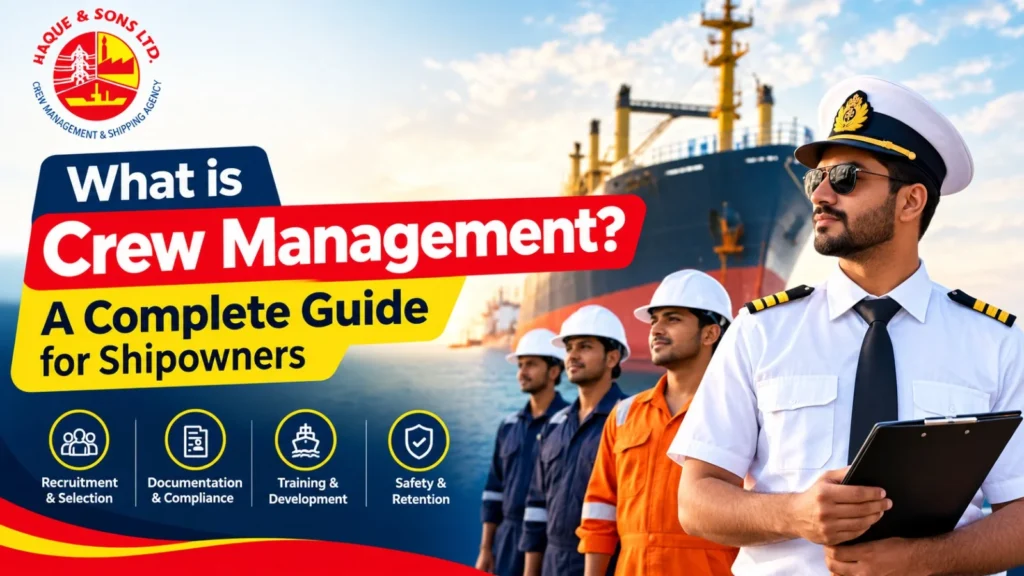
Ship ownership is not merely a matter of keeping the boat up and running and its business going. The crew on board are equally crucial. Qualified and well trained, medically fit and supported seafarers are essential for a ship’s safe and efficient operation. This is where crew management comes in.
In essence, what is crew management?
Crew management refers to the management of personnel on board a ship during their career. This may involve recruiting seafarers, crew planning, certification and document checks, crew scheduling, deployment, payroll coordination, training, welfare, performance management and repatriation.
In ship ownership, good crew management practices are vital to ensure the appropriate crew members are in place for certain roles while maintaining regulatory standards and promoting seafarer well-being. It plays a crucial role in the management of a modern ship and can be done in-house or with a professional crew management company like Haque & Sons Ltd.
Crew Management in Shipping Explained
Crew management is the orderly provision and administration of suitably experienced manpower in a ship in the maritime industry.
A crew management team may be tasked with recruiting appropriate officers and ratings for the vessel, checking their qualifications and certificates, arranging crew changes, monitoring their contracts, arranging travel, keeping crew records and assisting seafarers while on board. Coordination of joining and travel is often handled alongside marine travel and logistics services.
The exact responsibilities will vary depending on the contract between the shipowner and the ship manager.
Managing the crew is not only a matter of recruiting individuals to fill in. It is a continuous process that might start with recruitment and end with repatriation after completion of the contract, following training and deployment and onboard support.
An organized crew management process can make this situation much easier to coordinate for shipowners that run more than one vessel.
Why Is Crew Management Important for Shipowners?
A ship must have a competent crew in order to operate safely. Meanwhile, the ship owners have to deal with a variety of regulatory, operational and human resources tasks.
Crew management is the area that combines all of these.
By managing a crew operation properly, shipowners can ensure they maintain the correct manning levels, ensure that documentation is up to date, plan crew changes and ensure that training and certification needs do not become operational issues.
Crew welfare is also directly linked to the operation of a vessel. Seafarers work and live away from home for long periods and their working and living situations can impact the morale, retention and overall performance onboard.
The Maritime Labour Convention, 2006 (MLC, 2006) sets standards for important aspects of seafarer employment and welfare, such as employment contracts, hours of work and rest, wages, repatriation, medical care, accommodation, food, health and safety, and complaint procedures. The convention came into force in 2013 and has been amended.
This puts crew management on the operational agenda and the people management agenda.
What is the Purpose of a Crew Management Company?
The crew management company is an extension of the shipowner’s management team onshore, depending on the services provided.
It is one of its fundamental duties to recruit and select crews. This includes finding crew members with the necessary skills, experience, licenses and other qualifications that are suitable for the job and ship, often supported by a maritime training and education programme.
Crew managers can also be responsible for processing, issuing and keeping records of certificates, medical fitness, training and employment records.
Following successful crew selection, the management process moves on to joining arrangements, travel coordination, crew changes, administration of payroll and onboard support. Read our Chattogram Port crew change guide for a practical look at how sign-on/sign-off is handled in Bangladesh.
A professional service might also be able to help shipowners when it comes to crew planning and succession, ensuring that they are aware of future ship contracts coming up and don’t encounter any last-minute problems when arranging for future crew replacements.
The outcome is a streamlined way of handling the whole seafarer lifecycle.
Compliance, Training and Certification
It’s not just about recruiting, it’s also about a crew member’s qualification. Continuous training and certification control is a vital aspect of crew administration under maritime rules and requirements.
Crew managers must ensure they are aware of and up to date with related certificates, medicals, training needs and expiration dates.
STCW Convention is at the heart of the international standards for seafarer training, certification and watchkeeping. Crew management systems thus must consider the qualifications and certification needs of the type of positions being filled. See our detailed breakdown of STCW certification, courses, validity and renewal for Bangladeshi seafarers.
Compliance with MLC is also crucial for employment and welfare reasons. According to ILO, the convention addresses the following aspects of employment: agreements, hours of work and rest, wages, repatriation, medical care, accommodation, food, health and safety, and complaint procedures.
Requirements may vary for different flag states and for ships, and shipowners should make sure that their crew management arrangements are in accordance with the requirements that apply to their ships.
The Support Provided To Seafarers and Crew Welfare
Managing a crew isn’t just about paperwork and schedules.
It is important to keep a vessel’s crew supported throughout its contract, which includes seafarer welfare. This includes communication with crew members, support with employment issues, medical co-ordination, repatriation arrangements, and handling concerns raised while in service.
The MLC, 2006, is dedicated to setting minimum standards for seafarers’ working and living conditions. The ILO’s existing guidance also incorporates more recent developments on topics like social connectivity, seafarers’ protection from violence and harassment, abandonment, and other seafarer welfare issues.
By making welfare an integral part of the crew management process, rather than an add-on, shipowners can help to build a more sustainable connection with seafarers. Explore how Haq Sons supports seafarers throughout their career and welfare journey.
Changes in Crew and Return of Personnel
Crew changes are an integral part of vessel operations and are well coordinated.
Once one sailor has served his or her term, another may have to ship to the next appropriate port. The departing person can then need to be driven home.
Involves coordination among the vessel, the shore office, the crew member, travel providers, agents, and possibly more than one authority.
Flights may have to be rescheduled or a replacement may not be able to arrive as scheduled, which can result in costly delays.
Crew management can assist in organising these and keep ties with incoming and outgoing crew members — see our step-by-step crew change process at Chattogram Port for documents and timelines.
Relevant rights and responsibilities in relation to the return of seafarers to their home port where applicable and in certain circumstances is also an important aspect of the MLC, 2006.
What Should Shipowners Consider When Choosing a Crew Management Company?
The selection of a crew management provider is a significant choice as it could become part of an owner’s critical and sensitive operational aspects of the business.
Review the recruitment system, the company’s track record with the vessel type(s) in question, documentation/certification procedures, the availability of crew, training requirements, the scheme of welfare and communication.
It is also helpful to learn about the company’s emergency, crew change, repatriation, payroll and compliance procedures.
The relationship between the crew and management should be transparent. Owners should understand the responsibilities for each aspect of the process and the monitoring of performance and compliance.
In the context of shipping management, Haque & Sons Ltd can serve as a professional partner for companies seeking comprehensive support in managing the human aspect of shipping operations, including crew coordination and other related needs.
Crew Management vs Crew Manning: What’s the Difference?
Sometimes the two terms are used as synonymous but they may refer to different levels of service.
The provision of or assignment of qualified manpower for ships is usually the scope of crew manning.
Crew management is more general. It can encompass recruitment and placement, but may also involve crew planning, documentation, training, payroll management, welfare, travelling, crew changes, performance and repatriation.
The exact definition may vary based on the contract and specific services provided by a specific maritime company in practice.
Shipowners are thus advised to consider the actual services provided and not just the name given by a service provider.
How Technology is Transforming Crew Management
Digital systems are now playing a more and more important role in modern crew management.
Companies can use the crew database to keep track of qualifications, certificates, medical records, employment history and contract details. Automated reminders can also be used to highlight upcoming certificate expirations or contract completion dates.
Digital communication allows for better information sharing between a team on shore and a vessel, and centralized systems can help management with a more comprehensive overview of crew availability and future needs.
Technological solutions are not meant to replace good old-fashioned crew managers. Instead, it can help minimize administrative tasks and streamline access and management of essential information.
It can be particularly useful for shipowners who have several ships.
Common Questions on Crew Management
Crew Management in Shipping: What is it?
Crew management is the recruitment, selection, training, deployment, support and management of crew during the seafarer’s employment on a vessel.
What is a crew management company?
Depending on the scope of services, a crew management company can recruit and certify seafarers, conduct crew checks, arrange crew scheduling, travel arrangements, crew changes, payroll administration, training coordination, welfare, and repatriation.
Why is it necessary to manage crew on board a ship?
Effective crew management assists shipowners to keep their crews qualified, properly documented, and contributes to the operation of their vessels, compliance with regulatory requirements, crew welfare, and efficient crew planning.
What is the difference between crew management and crew manning?
Crew manning usually means providing or placing seafarers on board ships; crew management refers to the wider process, which involves recruitment, scheduling, documentation, welfare, training and repatriation of seafarers.
What is MLC 2006 and how does it relate to crew management?
The International Maritime Labour Convention 2006 contains minimum standards for the working and living conditions of seafarers internationally. It addresses topics such as employment contracts, remuneration, working and rest times, repatriation, medical treatment, accommodation and food, health and safety, and complaints.
What is STCW in Maritime Crew Management?
STCW is the International Convention on Standards of Training, Certification and Watchkeeping for Seafarers. It sets international standards in seafarer training, certification and watchkeeping, which is important to consider when choosing and running a qualified crew — see our STCW certification guide for details.
Final Thoughts
One of the keys to efficient ship operation is crew management. A ship can be well equipped, processes can be streamlined, and business plans can be well formulated, but they won’t get the job done without competent personnel.
Crew management encompasses a wide variety of aspects, from crew recruitment to crew scheduling, certification, training, crew welfare, crew exchange and crew repatriation.
It’s not just about filling vacancies when shipowners are concerned — it’s about establishing and maintaining a dependable system to ensure the availability of competent seafarers, accurate records, proper support and readiness to fulfil their duties.
As a shipping management firm, Haque & Sons Ltd. can assist ship owners in tackling these responsibilities by organizing crew management and providing maritime management assistance. Ultimately, it’s the right crew management strategy that brings people, compliance and vessel operations together in a manner that enables more efficient day-to-day shipping operations. To discuss your fleet’s crewing needs, contact the Haque & Sons Ltd team.