
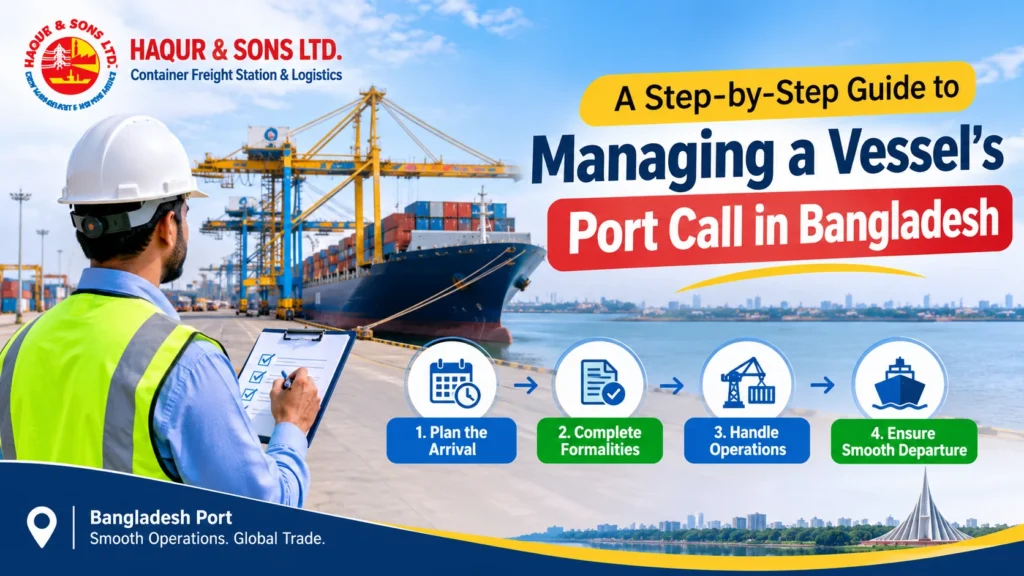
A vessel’s port call looks simple from a distance — arrive, load or discharge, depart. In practice, it’s a tightly sequenced operation involving port authorities, customs, surveyors, suppliers, and the ship agent coordinating all of it in parallel. A delay in any one step extends the vessel’s turnaround time and directly affects the owner’s bottom line. Here’s how a well-managed port call actually unfolds in Bangladesh.
Step 1: Pre-Arrival Notice and Planning
The ship agent receives the vessel’s ETA, cargo details, and operational requirements typically 5–7 days before arrival. At this stage, the agent:
- Submits pre-arrival notifications to port authorities and customs
- Confirms berth availability and pilotage scheduling
- Coordinates with the charterer/owner on cargo documentation requirements
- Flags any anticipated husbandry needs (bunkers, repairs, crew changes, provisions)
Step 2: Port Entry and Pilotage
As the vessel approaches Bangladesh’s territorial waters, the agent coordinates pilot boarding, tug assistance (if required), and berth allocation with the port authority. Any documentation discrepancies at this stage — manifest errors, missing permits — can hold a vessel at anchorage, so this is where an experienced agent’s relationship with port control matters most.
Step 3: Customs and Immigration Clearance
Once alongside, customs and immigration officials board for clearance. The agent handles:
- Submission of the ship’s manifest, crew list, and relevant certificates
- Facilitating customs inspection where required
- Coordinating immigration formalities for crew sign-on/sign-off, if applicable (see our crew change process guide for this specific workflow)
Step 4: Cargo Operations Coordination
Whether the vessel is loading or discharging crude, chemicals, bulk, containers, or general cargo, the agent coordinates between the vessel, terminal operators, stevedores, and surveyors to keep operations on schedule. This includes monitoring load/discharge rates against the charter party’s laytime terms and flagging any delays that could trigger demurrage claims.
Step 5: Husbandry and Owner’s Matters
While cargo operations proceed, the agent typically manages a parallel set of owner’s-matter tasks:
- Bunker supply coordination with approved suppliers
- Fresh water and provisions delivery
- Ship repairs arranged with local contractors if needed
- Medical attention for crew, if required
- Spare parts clearance through customs
- Classification society survey coordination, if a periodical survey falls due during the call
Explore our port agency services for the full scope of husbandry support available during a Bangladesh port call.
Step 6: P&I and Claims Matters
If any cargo damage, crew incident, or claim arises during the call, the agent acts as the owner’s local representative — coordinating with P&I correspondents, surveyors, and local authorities to protect the owner’s position before the vessel departs.
Step 7: Departure Clearance
Before sailing, the agent secures:
- Port clearance from customs and immigration
- Final port dues settlement
- Updated crew list and documentation for the next port of call
- Confirmation of pilotage for departure
Step 8: Post-Call Documentation and Reporting
After departure, the agent compiles the Statement of Facts (SOF), final port disbursement account, and any survey or claims documentation for the owner’s records — closing out the port call administratively.
What Separates an Efficient Port Call From a Delayed One
The difference usually isn’t the port itself — it’s the agent’s preparation and local relationships. Agents who pre-coordinate with customs, terminal operators, and suppliers before the vessel arrives consistently achieve faster turnarounds than those reacting after arrival. For shipowners, this is the real value of choosing an established ship/port agency with decades of local relationships, not just lowest-quoted agency fees.
Managing Multiple Service Needs in One Port Call
Many port calls also involve crew changes, which is why shipowners increasingly prefer an agency that handles ship agency, port agency, and crew management together — removing the coordination gap between separate providers during a single, time-sensitive port call.
Partner With an Experienced Port Agent in Bangladesh
Haque & Sons Ltd. has served as a handling agent for liner and tramp vessels, and owners’ protecting agent for chartered ships, across Bangladesh’s major ports since 1972. Contact our port agency team before your vessel’s next call to Bangladesh.
Frequently Asked Questions
How much advance notice does a ship agent need before a vessel’s arrival in Bangladesh?
Typically 5–7 days, to allow time for berth confirmation, customs pre-clearance, and husbandry arrangements.
What causes the most delays during a Bangladesh port call?
Documentation discrepancies at arrival and uncoordinated husbandry requests (bunkers, repairs) raised after the vessel has already berthed.
Can one agency handle both port agency and crew change needs during the same call?
Yes — agencies offering integrated ship agency and crew management services can coordinate both within a single port call.